
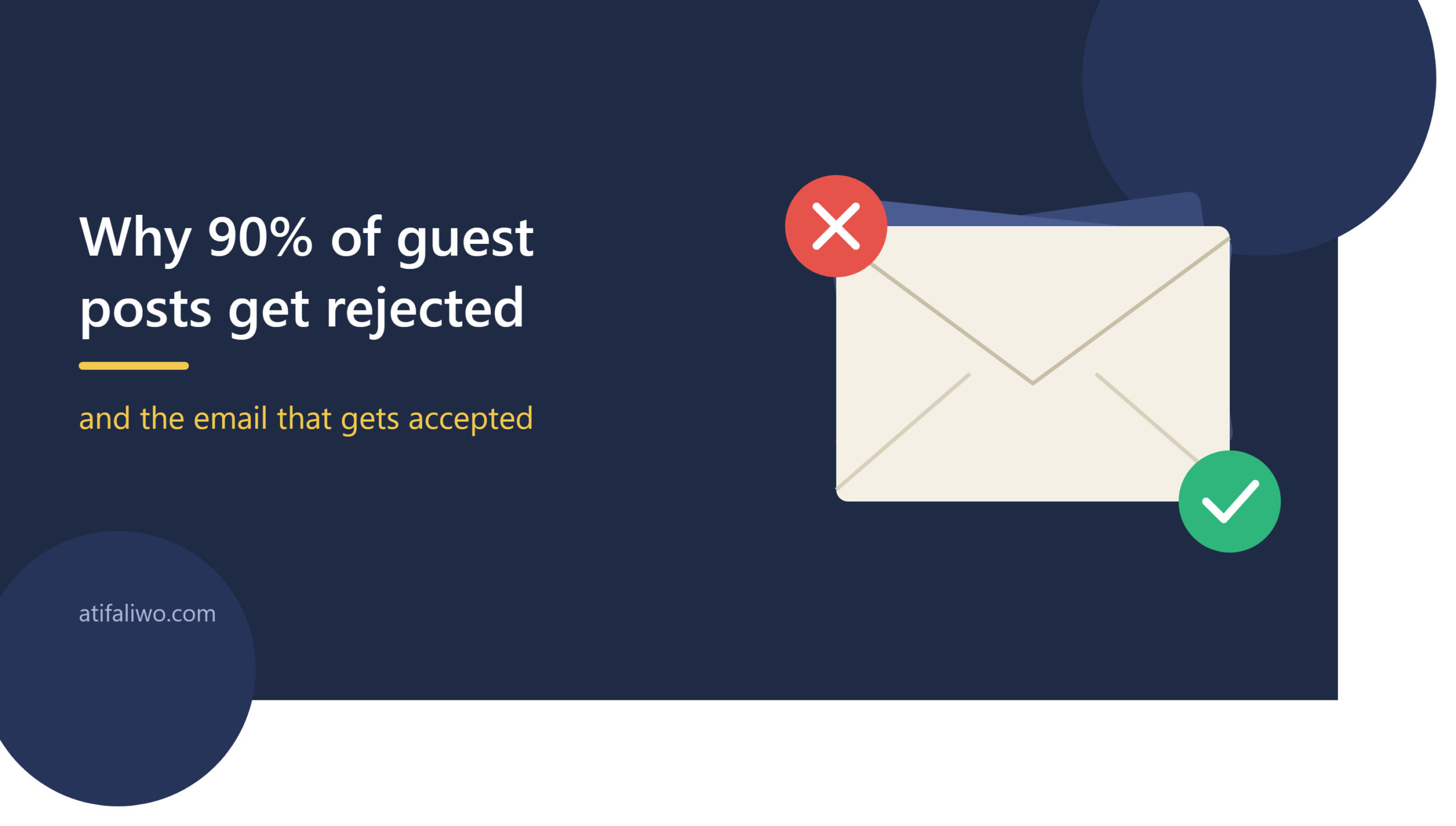
Why 90% of Guest Posts Get Rejected (and the Email That Gets Accepted)
By Atif Ali | atifaliwo.com
You spent hours writing the perfect article. You researched the topic, polished every sentence, and sent it to ten websites. Then you waited. And waited. Zero replies.
If that sounds familiar, you’re not alone. Most editors decide whether to accept a guest post within seconds, and the vast majority of pitches never make it past that first glance. The exact rejection rate varies from site to site, but “around 90%” is a fair rule of thumb for how many cold pitches get ignored or declined. The good news is that the reasons are surprisingly consistent, which means they are fixable.
In this guide, you’ll learn exactly why guest posts get rejected, what editors are really looking for, and see a guest post pitch email template you can adapt today to raise your acceptance rate and earn quality backlinks.
Why Guest Posting Still Matters in 2026
Before we get into the mistakes, it helps to remember why this is worth getting right. Guest posting is still one of the most reliable ways to build backlinks, reach a new audience, and establish yourself as a credible voice in your niche. A single well-placed article on a respected site can send targeted traffic for years and strengthen your own site’s authority.
But that value is also why editors are flooded with low-effort pitches. Standing out isn’t about writing more. It’s about avoiding the mistakes that get most people deleted.
The 7 Reasons Your Guest Post Gets Rejected
1. You Sent a Generic Pitch
“Hi, I want to write for your website” tells the editor nothing. They don’t know your topic, your skill level, or why their readers would care. Editors receive dozens of these every week, and copy-pasted messages are the easiest to spot and delete.
The fix: Mention the site by name, reference a specific article you read, and propose a specific topic.
2. The Topic Doesn’t Fit Their Audience
A finance blog won’t publish your travel tips, no matter how well written they are. Many rejections have nothing to do with quality. They happen because the pitch simply doesn’t match what the site publishes.
The fix: Read their last 10 posts before you pitch. Notice the tone, the formats, and the kinds of readers they serve.
3. The Article Is a Sales Pitch in Disguise
If every paragraph pushes your product or drops links to your own pages, editors see an advertisement, not a helpful article. Sites protect their readers’ trust, and overly promotional content puts it at risk.
The fix: Lead with value. Keep your links relevant, limited, and genuinely useful to the reader.
4. You Ignored the Guidelines
Most sites have a “write for us” page that lists word counts, formatting rules, topics they accept, and link policies. Skipping it signals that you don’t respect their time, and it is one of the fastest ways to get rejected.
The fix: Read the guidelines twice, then follow them exactly.
5. The Content Already Exists
If a site has covered a topic five times, they won’t publish a sixth copy. Recycled advice, such as “10 basic SEO tips”, rarely earns a yes.
The fix: Search the site for your topic first. Offer a fresh angle, new data, a personal case study, or a topic they haven’t covered yet.
6. The Writing Quality Is Weak
Typos, long walls of text, thin research, and vague claims all hurt your chances. Editors don’t want to spend hours rewriting your draft. They want something close to ready to publish.
The fix: Use short paragraphs, clear headings, concrete examples, and a careful proofread before you send.
7. You Look Like a Link Seeker, Not a Contributor
If your pitch focuses on “getting a backlink” instead of helping their readers, editors will notice. Pitches that mention link exchanges, paid placements, or “dofollow only” requests in the first message often land in the trash.
The fix: Show that you care about their audience first. The backlink is a fair benefit of your contribution, not the headline of your pitch.
What Editors Actually Want
When you strip it all down, editors are asking three questions:
- Is this relevant to my readers?
- Is it original and genuinely useful?
- Will this person be easy and reliable to work with?
Every strong pitch answers all three quickly, ideally within the first few lines.
The Guest Post Pitch Email That Gets Accepted
Here is a simple template. It’s short, specific, and focused on them rather than you.
Subject: Guest post idea: [Specific Topic] for [Their Audience]
Hi [Name],
I’ve been reading [Site Name], and your post on [specific article] was really useful, especially [one real detail].
I’d love to contribute an article called “[Your Headline].” It would cover:
- [Point 1]
- [Point 2]
- [Point 3]
I noticed you haven’t covered [gap] yet, so this would be new for your readers. I can send a full draft within 5 days, unique and unpublished anywhere else.
Here are two samples of my work: [link 1], [link 2].
Thanks for your time, [Your Name]
Why This Email Works
- It’s personal. Naming a specific article proves you actually read the site.
- It offers a gap. You’re solving a problem for the editor, not asking for a favor.
- It lowers the risk. Writing samples and a clear deadline show you’re reliable.
- It’s short. Under 150 words respects the editor’s time.
Subject Line Tips That Boost Open Rates
Your subject line decides whether the email is read at all. Keep it specific and honest:
- “Guest post idea: [Topic] for [Site Name] readers”
- “Article pitch: [Specific headline].”
- “Fresh angle on [Topic] for your audience”
Avoid vague or spammy lines like “Collaboration opportunity” or “Quick question”.
How to Follow Up Without Being Annoying
No reply doesn’t always mean no. Editors are busy, and emails get buried. A polite follow-up after 5 to 7 days can make the difference.
Hi [Name], just following up on my guest post idea about [Topic]. I’d be happy to adjust the angle if it helps. Thanks again for considering it.
Send one follow-up, maybe two at most. After that, move on and pitch another site.
Quick Checklist Before You Hit Send
- Did I read their guidelines?
- Is my topic new for their site?
- Is my pitch under 150 words?
- Did I include writing samples?
- Does my article help readers first and promote me second?
- Did I proofread the email and the draft?
Frequently Asked Questions
How long should I wait for a response to a guest post pitch?
Wait 5 to 7 days before sending a polite follow-up. Many editors take a week or more to respond.
Should I send the full article or just a pitch?
Most sites prefer a short pitch first. Send the full draft only if their guidelines ask for it.
How many guest post pitches should I send?
Quality beats quantity. Ten personalized pitches usually outperform a hundred copy-pasted ones.
Can I include links to my own website?
Yes, but keep them relevant and limited. Most sites allow one or two contextual links, often in the author bio.
What if my guest post gets rejected?
Treat it as feedback. Ask politely if there’s a topic they’d prefer, improve the piece, and pitch it to another relevant site.
Final Thoughts
Guest posting isn’t about volume. It’s about relevance, respect, and value. Most rejections come from a handful of avoidable mistakes: generic pitches, off-topic ideas, promotional content, and ignored guidelines. Fix those, use a clear and personal pitch email, and your acceptance rate will climb.
Pitch fewer sites, personalize more, and focus on helping their readers first. The backlinks will follow.
Looking for places to pitch? Check out our [Top 100+ guest posting website list] and our [Ultimate Guide: Guest Blogging for Traffic and Backlinks] to get started.



One Comment
[…] Most rejections happen because writers ignore the rules. Note the word count, whether links are allowed, formatting requirements, and what topics the editor wants. For more on this, read our guide on why 90% of guest posts get rejected. […]